
A devastating landslide in Mumbai's Ghatkopar area, triggered by heavy rains, has claimed the lives of six people, including three children, and left four others injured, with rescue operations facing significant challenges due to the narrow access routes.
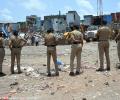
Mumbai police have arrested sixteen people and are seeking over 150 more in connection with stone pelting incidents that occurred during a demolition drive near Bandra station. The demolition aimed to clear encroached land for railway infrastructure upgrades.

Police in Maharashtra have arrested three individuals in connection with an attempted break-in at a jewellery store in the Palghar district. The suspects were apprehended in Thane city following an investigation that included CCTV footage analysis.

Twelve persons, arrested in 2006 for their involvement in the July 11, 2006 serial train blasts case, were acquitted by the Bombay high court on Monday.

Farhan Akhtar seems proud of 120 Bahadur, his second war epic after Lakshya -- he doesn't direct this one, he stars in it -- and invited film folk to a special screening in Mumbai.

Rashmika Mandanna gets us in the mood for Holi with her new song Bam Bam Bhole in Sikandar.

The Bombay High Court acquitted all 12 accused in the 2006 Mumbai train blasts case, citing a failure by the prosecution to prove their guilt and raising serious concerns about the investigation and evidence presented.
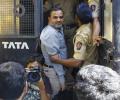
On Wednesday, the special MCOCA court in Mumbai awarded death sentences to Kamal Ahamed Ansari, 37, Mohd Faisal Shaikh, 36, Ehtesham Siddiqui, 30, Naveed Hussain Khan, 30 and Asif Khan, 38, for the role they played in the 7/11 Mumbai train blasts, which claimed the lives of 188 people.

Tahawwur Hussain Rana, a Canadian national convicted in the United States for his role in the 2008 Mumbai terror attacks, has been extradited to India. Rana, a close associate of Pakistani-American terrorist David Coleman Headley, was involved in the conspiracy from 2005 onwards and assisted Headley in obtaining a visa for India. He is the third person to be sent on trial in India for the 26/11 attacks after Ajmal Kasab and Zabiuddin Ansari alias Abu Jundal. Rana's extradition comes after US President Donald Trump approved the request.
It also extended the police custody of another accused after the Anti-terrorist Squad said it wanted to take him to Bangalore for a narco-analysis test.
In the other semi-finals, East Bengal dominated the match with a 2-0 win over Dempo.
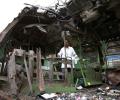
A Special MCOCA court has convicted 12 of the 13 accused in the July 11, 2006 Mumbai suburban train bombings in which 188 people were killed.

Nine years after seven RDX bombs kept in Mumbai suburban trains exploded killing 188 people, a Special Maharashtra Control of Organised Crime Act court is likely to pronounce its verdict on Friday.

'He is the key to unravel the 26/11 conspiracy.'

'The police wasted nine years of his precious life. Who will compensate him now?' a relative of Abdul Wahid Shaikh, the only person acquitted in the 2006 Mumbai train blasts case, ask Syed Firdaus Ashraf/Rediff.com

Terror operative Abu Jundal's trial on December 9 is likely to open a new war of words, for his claims on another LeT operative Sajid Mir, who, Jundal has claimed that was a 'khaas aadmi' of the ISI. Vicky Nanjappa reports
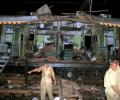
Seven years after the Mumbai serial train blasts in which nearly 200 people were killed and over 700 injured, the trial in the case is still going on with the special Maharashtra Control of Organised Crime Act court recording the statements of the accused. "The court is now recording the statement of the accused who wanted to depose as a defence witness in the case," said advocate Sherif Sheikh, appearing for some of the accused in the case

"Considering their role, eight convicts deserve death penalty," the prosecution told the court.
The case took a twist when the defence lawyer sought to call Indian Mujahideen co-founder Sadiq Sheikh as a defence witness after he told the police in 2008 that IM members were responsible for all the blasts that had occurred in India since 2005 including the July 11, 2006 train blasts.

Three persons with alleged "ideological leaning" towards the banned JeM were arrested in New Delhi for planning terror strikes in different parts of the national capital.

Pronouncing the verdict, the special Maharashtra Control of Organised Crime Act (MCOCA) court judge Yatin Shinde sentenced to death Faisal Sheikh, Asif Khan, Kamal Ansari, Ehtesham Sidduqui and Naveed Khan who planted the bombs in various trains.
All 12 convicts found guilty in the case relating to the July 11, 2006 serial train blasts, which claimed 188 lives in local trains in Mumbai, have pleaded leniency in the court on the point of sentence citing humanitarian grounds.
Abu Jundal gives interrogators information on Sajid Mir, two Majors and Zarar Shah -- all four of whom were in the 26/11 control room in Karachi

A Mumbai court trying the case of Lashkar-e-Taiba operative and 26/11 key handler Sayed Zabiuddin Ansari alias Abu Jundal, on issued non-bailable warrant against 12 more accused in the Mumbai terror attacks case.

13 persons were picked up by the Special Cell after a late night operation on Tuesday. Of them, three -- Sajid, Sameer Ahmed, and Shakir Ansari -- have been arrested, four let off and six are still being questioned by the investigators.

The National Investigation Agency on Wednesday filed its charge sheet in a Delhi court against five suspected operatives of terror outfit Indian Mujahideen for their alleged involvement in hatching a conspiracy to carry out terror strikes in the country.
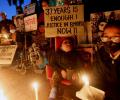
Thirty-seven years and some three generations later, the darkness of that night when 40 tonnes of lethal methyl isocyanate leaked out of the Union Carbide plant hangs like an impenetrable cloud over the lives of untold thousands, including children as young as three whose parents were exposed to the toxin when they themselves were children.

While Ayodhya resembled a city under seige earlier during the day, the scene was no different elsewhere in the state with police and central forces keeping an eye over the security situation and Chief Minister Yogi Adityanath personally monitoring it from a hi-tech control room in the state capital.

The Lashkar-e-Tayiba operative also revealed about his training while he deposed in front of a Mumbai court via video link.

Lashkar-e-Tayiba and the Al Qaeda were convinced that 26/11 attack masterminds Hafiz Saeed and Zakiur Rehman would face only "superficial" action from the Pakistani authorities and within months plans were afoot for another terror strike in India, Pakistani-American terrorist David Coleman Headley said on Saturday.
